
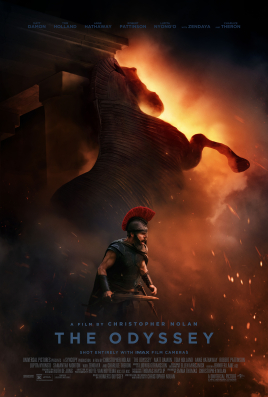
Christopher Nolan does not make small movies, and with The Odyssey, his first attempt at bringing Homer’s foundational epic to the screen using true IMAX film cameras, he swings bigger than ever. Matt Damon leads as Odysseus, the king of Ithaca fighting his way home after the fall of Troy, in a nearly three-hour epic shot across the UK, Morocco, and Italy on a budget north of two hundred fifty million dollars. It is, without question, one of the most ambitious theatrical bets of the year, and for most of its runtime, it earns that ambition.
The Setup
The film opens with a framing device, a storyteller recounting the fall of Troy before the wider journey begins, and that choice tells you exactly what Nolan is interested in here. This is not just a survival adventure through monsters and open water. It is a film about the stories people tell to make sense of war, loss, and the long road back from both, and Nolan uses that lens to make a two-thousand-year-old text feel like it is speaking directly to the present moment.
Damon anchors the film as a man who has spent a decade at war and does not fully know how to stop being a soldier, and Nolan surrounds him with a cast list that reads like he called in every favor he has collected over two decades. Tom Holland, Anne Hathaway, Robert Pattinson, Zendaya, Lupita Nyong’o, and Charlize Theron all appear, alongside longtime collaborators clearly willing to sign on for something this large in scale.
What Works
The setpieces are where this movie earns its money. Nolan stages the mythic material, the creatures, the storms, the impossible geography of Odysseus’s journey, with the same practical, tactile instinct he brought to Dunkirk and Oppenheimer, and it pays off in sequences that feel like something rather than a wall of digital noise. Shooting on real IMAX film instead of leaning on digital shortcuts gives the whole production a weight and texture that has become rare in modern blockbusters, and the ensemble holds up its end as well. The supporting cast gets enough room to leave a mark instead of disappearing into the spectacle surrounding them.
Where It Stumbles
For as impressive as The Odyssey is to look at, it keeps its audience at arm’s length more than it should. This is fundamentally a story about a man desperate to get home to his wife and son, and that emotional pull should be the engine of the whole film, but Nolan’s clinical, technically obsessed style occasionally works against the material’s heart. There is more admiration here for the craft than there is genuine feeling for the journey, which is a real cost for a story this personal at its core. The nearly three-hour runtime asks a lot of its audience too, and the back half is clearly more interested in mythic scale than in Odysseus the person.
It is a familiar Nolan tension. Few filmmakers working today can build something this massive and meticulous, but that same instinct can flatten the more intimate stakes sitting underneath it.
The Verdict
The Odyssey is a genuine achievement, a big-swing epic that few studios would have the nerve to greenlight anymore, and on a technical level it may be Nolan’s most impressive work yet. It simply does not close the gap between spectacle and feeling, which keeps it a notch below his very best. Even so, this is exactly the kind of movie that deserves to be seen on the largest screen available, and it earns its place among the year’s biggest theatrical events.
The Odyssey is now playing in theaters. Rated R. Directed by Christopher Nolan. Written by Christopher Nolan, based on the Odyssey by Homer. Runtime: 2 hours 53 minutes. A Universal Pictures release.
For more movie reviews and entertainment coverage, visit PressPlayReview.com.