
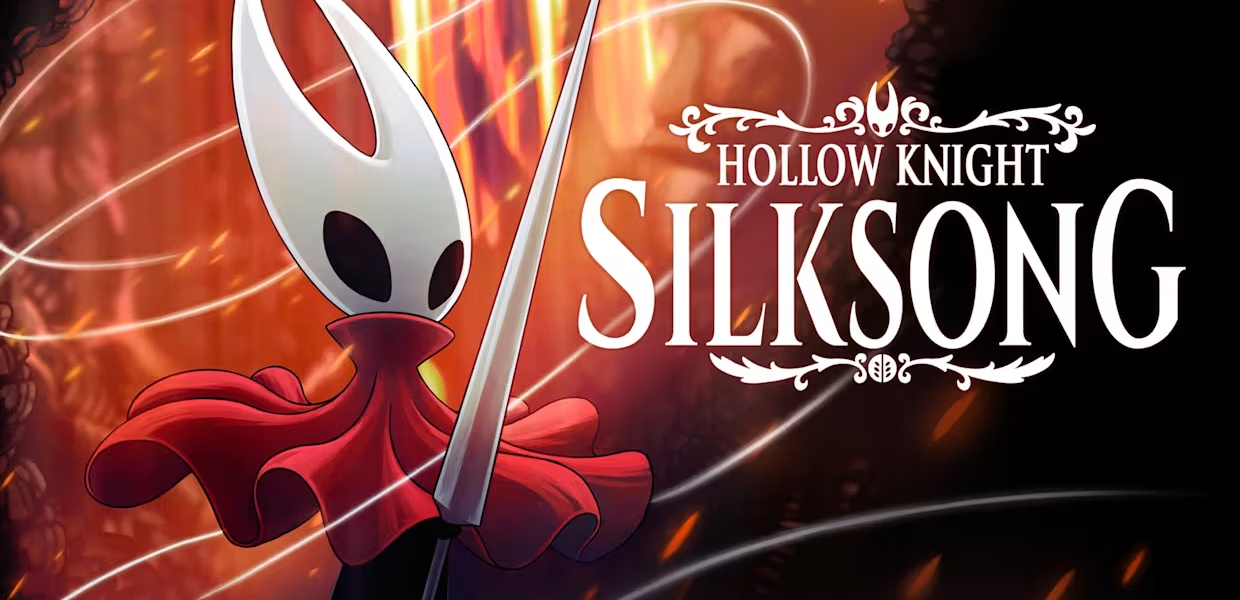
Let’s start with the meme, because you cannot talk about Hollow Knight: Silksong without talking about the meme. For six years, from its announcement in February 2019 to its release on September 4, 2025, Silksong became the internet’s most beloved running joke about delayed games. Every gaming showcase was greeted with the same ritual: fans would put on their clown makeup, dare to hope, and then be let down again. A YouTube channel called Daily Silksong News uploaded a video every single day for over three years. Most of them contained the same script. There has been no news to report for Silksong today.
When the release date finally arrived, confirmed via a nearly two-minute trailer that dropped without warning, the gaming internet broke in the best possible way. People cried. Streamers screamed. The Steam wishlist, which had climbed past 5.2 million, finally started converting. Silksong was real. It was coming. And it had a date.
Now it is here, seven million copies sold and counting, available on everything from PC to Switch 2 to Xbox Game Pass. The clown makeup came off. The question that replaced it was the harder one: is it actually good?
The answer is yes. Emphatically, beautifully, frustratingly, wonderfully yes.
The Setup
Silksong picks up after the events of Hollow Knight, though Team Cherry is characteristically tight-lipped about exactly which ending is considered canon. What matters is this: you play as Hornet, the princess-protector of Hallownest, who finds herself imprisoned and taken to Pharloom, a haunted kingdom ruled by silk and song. She escapes. She explores. She fights. She unravels a mystery that slowly reveals itself to be far stranger and more layered than the opening hours suggest.
If you played the original Hollow Knight, you know what Team Cherry is about. Dense, melancholy lore delivered almost entirely through environmental storytelling and cryptic NPC dialogue. A world that feels like it existed long before you arrived and will continue to exist after you leave. Characters who seem minor and become unforgettable. Silksong inherits all of that and builds on it. Pharloom is a different kingdom from Hallownest but it carries the same atmosphere of civilizations in decay, of rituals outlasting the people who started them.
Playing as Hornet
The biggest shift from the first game is the protagonist. Where the Knight was silent, slow, and methodical, Hornet is fast, aggressive, and vocal. She talks. She has opinions. She reacts to the world around her with a dry wit that makes her immediately more characterful than her predecessor. Learning to play as her takes some adjustment if you put serious hours into the original, but once it clicks it feels genuinely revelatory.
The movement system is the best in any Metroidvania I have played. Once you unlock the dash and sprint, the game opens up into something that rewards skill expression in a way that very few games in this genre manage. Dash attacks launch you forward, diagonal pogo moves let you chain aerial combos, side stabs cover gaps in your offense. The ceiling on what skilled players can do is remarkably high. Watching someone who has mastered the movement system fight a boss looks almost like a different game from a first playthrough.
The diagonal pogo, a new addition replacing the original’s straight-down bounce, is the one mechanical change that takes the longest to feel natural. The original’s pogo was intuitive and satisfying in its simplicity. This one requires more precision and has a steeper learning curve. Most players will come around to it. Some never will. That is a legitimate criticism and Team Cherry probably knew it going in.
The World
Pharloom is enormous. Team Cherry promised a bigger map than Hollow Knight’s already substantial world, and they delivered. The game spans areas that range from dreary graveyards to swampy lowlands to a genuinely bustling city filled with insectoid NPCs going about their lives. Each region has its own visual identity, its own enemy types, its own ambient mood. The art direction is stunning throughout. This is a team that knows exactly what it wants its world to look like and has the skill to execute on that vision at every level of detail.
The game features over 200 enemy types and around 40 boss encounters, some of which are among the best in the genre. The bosses are where Silksong is most confident. Each one feels designed around the specific toolset Hornet has at that point in the game, demanding that you actually use what you have learned rather than brute-forcing your way through. The difficulty is high, particularly in the later sections. Double damage compared to the original means early mistakes are punished hard. The long runbacks to boss arenas after dying are the one consistent frustration, a design choice that feels slightly at odds with how dynamic and fast the rest of the game is.
The Sound
Christopher Larkin returns to score Silksong, and it would be a genuine disservice to move on without spending time here. The Hollow Knight soundtrack was already one of the best original game scores of the last decade. Silksong matches it. The music shifts seamlessly between haunting ambient pieces that underscore the loneliness of exploration and propulsive, layered compositions that push boss fights into something genuinely cinematic. There are themes in this game that will stay with you long after you put the controller down. The sound design throughout reinforces every mechanic, every environmental shift, every moment of discovery.
The Price and What It Means
Silksong launched at twenty dollars. No season pass. No microtransactions. No battle pass. No day-one DLC carved out of the base game. Twenty dollars for somewhere between 30 and 60 hours of content depending on how thoroughly you play, with a free expansion called Sea of Sorrow already confirmed for 2026. In the current landscape of gaming, that pricing is almost confrontationally fair. It is a statement. Team Cherry made the game they wanted to make, priced it at what they felt it was worth to a player rather than what they could extract from them, and let the quality do the rest. Seven million copies sold suggests that approach works.
The Weak Spots
No review of Silksong would be honest without acknowledging where it falls short of the original. The bosses, while excellent individually, lack the iconic quality of Hollow Knight’s best encounters. The Hollow Knight himself, Grimm, Nightmare King Grimm, Pure Vessel, these are among the most memorable boss fights in gaming. Silksong’s roster is strong but does not quite reach those heights. Whether that is because the original set an impossibly high bar or because Silksong’s bosses genuinely lack that final spark of memorability is something players will debate for years.
The story is also more opaque than usual, even by Team Cherry standards. Pharloom’s mystery unfolds slowly and rewards players who dig deep into every corner and piece of dialogue. Those who play more casually may finish the game with more questions than answers and find that unsatisfying. That is a deliberate choice on Team Cherry’s part, but it is worth flagging.
The Verdict
Hollow Knight: Silksong is a masterpiece of the Metroidvania genre. It is the rare sequel that honors everything that made its predecessor great while finding its own identity, its own rhythm, its own reason to exist. Playing as Hornet feels distinct from playing as the Knight in ways that matter, and Pharloom is a world worth getting lost in for dozens of hours. The six-year wait produced something that, against all reasonable expectation, actually justified it.
The daily Silksong news channel finally had something to report. It was worth every day.
Hollow Knight: Silksong is available now on PC, PS4, PS5, Nintendo Switch, Nintendo Switch 2, and Xbox Game Pass. Developed by Team Cherry. Rated E10+.
For more game reviews and entertainment coverage, visit PressPlayReview.com.