
Let’s put this in perspective. The last time someone tried to make a live-action Masters of the Universe movie, it was 1987, Dolph Lundgren was in a loincloth, it cost $22 million, and it made $17 million back. The franchise spent the next nearly four decades wandering through cancelled productions, aborted scripts, and a revolving door of directors and studios. At various points Kevin Smith was attached. At other points it was set to happen at Sony. Nothing moved. Eternia was stuck in development hell longer than most of its fans have been alive.
So the fact that Travis Knight’s Masters of the Universe exists at all is kind of remarkable. The fact that it is actually good is more remarkable still.
The Setup
Prince Adam of Eternia, played by Nicholas Galitzine, crash-lands on Earth as a young man, separated from the Sword of Power and cut off from his home planet. Nearly two decades later, he discovers the truth about who he is, recovers the sword, and must return to Eternia to find it under the ruthless control of Skeletor. To do it he has to team up with Teela, played by Camila Mendes, and Duncan the Man-At-Arms, played by Idris Elba, and accept his destiny as He-Man, the most powerful man in the universe.
If that sounds familiar, it should. The film wears its Star Wars and chosen-one influences on its sleeve without apology. A young man of hidden royal lineage, separated from his home, learning his true power. The structure is not exactly original. But the execution has enough personality to make it feel like its own thing rather than a knockoff.
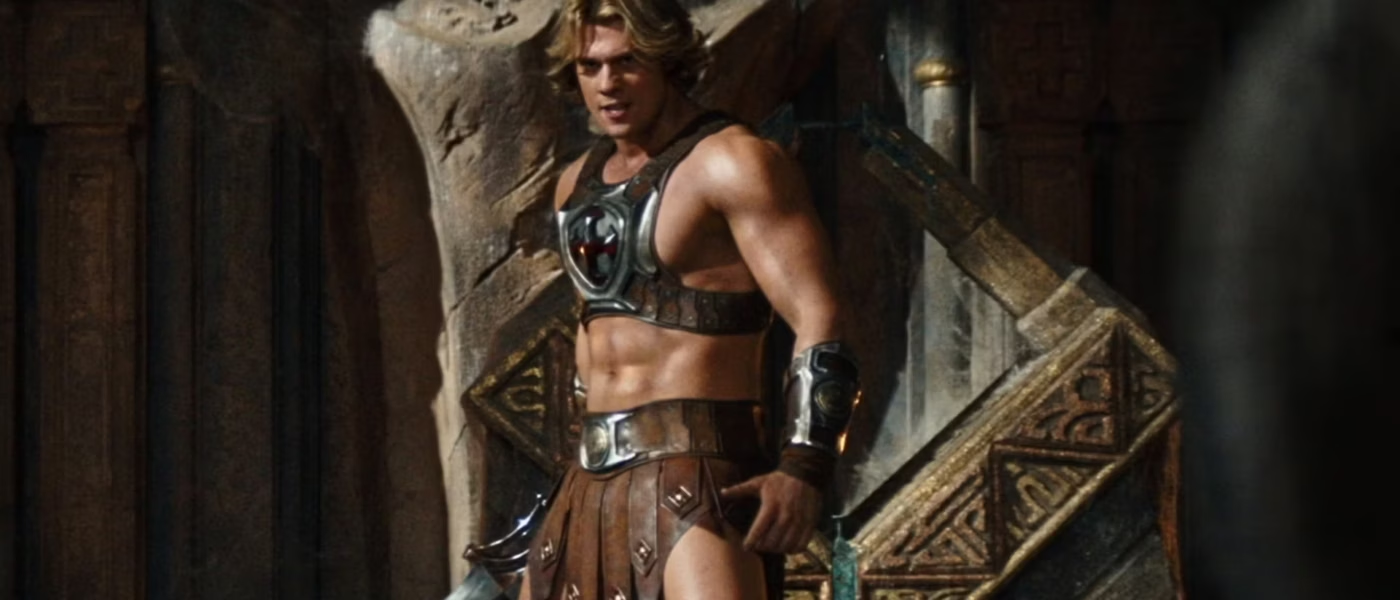
Nicholas Galitzine as He-Man
Galitzine has had a strange career trajectory. Red, White and Royal Blue made him a streaming star. The Idea of You turned him into something bigger. Now he is He-Man, which requires him to do something genuinely difficult: play a character called He-Man completely straight while Jared Leto is wearing a skull face across from him. He pulls it off. There is a physicality to the performance that goes beyond just looking the part, and Galitzine finds a warmth and earnestness in Adam that makes the more absurd elements of the film easier to buy into.
The physical transformation sequences are impressive. The film does not shy away from the sheer muscle-bound ridiculousness of the source material, which is exactly the right call. You cannot make a respectful Masters of the Universe movie. You can only make an enthusiastic one.
Jared Leto’s Skeletor
The voice is the thing. The physical performance, which blends practical makeup and costume work with digital enhancement, is impressive enough on its own. But Leto’s voice work as Skeletor is what makes the character genuinely memorable. Theatrical, contemptuous, with flashes of something almost comedic underneath the menace, his Skeletor is a villain who clearly enjoys himself. In a film that does not take itself too seriously, having a villain who also does not take himself too seriously turns out to be exactly right.
The Rest of the Cast
Idris Elba is reliably excellent as Man-At-Arms. Camila Mendes brings real energy to Teela, who could easily have been a thankless role and is not. Alison Brie as Evil-Lyn gets some of the film’s better moments. Kristen Wiig plays Roboto, a character whose casting only makes sense once you see it in context, and it works better than it should.
Then there is Hafþór Björnsson, the former World’s Strongest Man, playing a character called Goat Man. This is that kind of movie. It commits to the bit completely.
Dolph Lundgren also shows up for a cameo, acknowledging the 1987 film in a way that is actually quite good rather than just nostalgic box-ticking.
Travis Knight’s Direction
Knight directed Bumblebee, which remains one of the better Transformers films precisely because it understood that these properties work better when they are emotionally grounded rather than just spectacle delivery systems. He brings that same philosophy here. The action sequences are large and well-staged, but the film works hardest in its quieter moments, the scenes where Adam is figuring out who he is before the sword shows up and answers the question for him.
Daniel Pemberton’s score deserves a mention. It is big and adventurous in the way that 1980s fantasy scores were big and adventurous, which fits the material well and adds to the sense that Knight and his team understood what they were actually making.
The Mattel Question
This is the first film in the post-Barbie wave of Mattel adaptations to make it to screens, and it carries the weight of that context whether it wants to or not. The film is aware of the franchise’s history, full of Easter eggs for fans, and clearly built to launch a series rather than stand alone. That ambition is occasionally at odds with the film trying to also be a complete story in itself. The third act rushes slightly in ways that suggest a longer cut exists somewhere.
Some critics have found the tonal balance off, the film trying to be both a serious fantasy adventure and a camp classic simultaneously. That criticism is fair. It does not always land on one side or the other cleanly. But when it works, it works in a way that feels genuinely affectionate toward material that has spent forty years being treated as either embarrassing or impossible.
The Verdict
Masters of the Universe is not a masterpiece. The plot is familiar, the third act is rushed, and the film never fully resolves its identity as something sitting between genuine blockbuster and knowing camp. But it is a lot of fun, and it is made with evident love for the source material by people who understood that you cannot approach He-Man with ironic detachment. You have to mean it. Knight and Galitzine mean it, and the film is better for that.
After nearly four decades, Eternia finally got a real movie. It was worth the wait.
Masters of the Universe is now playing in theaters. Rated PG-13. Directed by Travis Knight. Distributed by Amazon MGM Studios. Runtime 141 minutes.
For more movie reviews and entertainment coverage, visit PressPlayReview.com.