
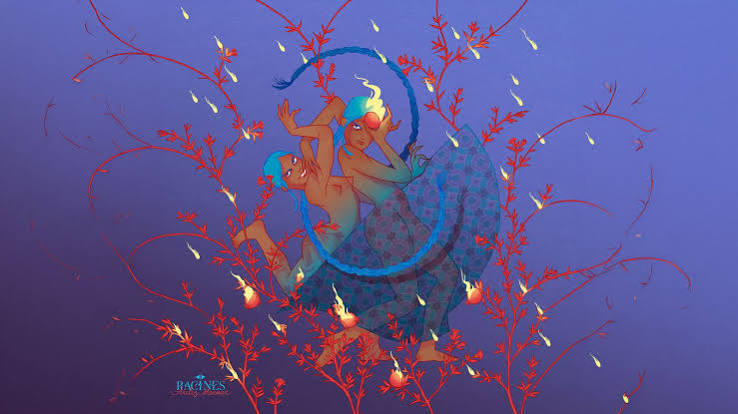
The name means roots. The title of the album means seeds drawn from the earth and set on fire. Between those two ideas sits everything Racines is trying to do, and on Arilos Mennar, their debut record on Locomotiv Records, they do it with a confidence and a beauty that is hard to overstate.
Rokeya was born in London with Indian, Italian, and Welsh heritage. She works as a producer, performer, selector, and curator. Anissa’s heritage spans Italy and Algeria, and she arrives as a singer-songwriter and multi-instrumentalist with a deep connection to traditional musical forms. Individually their creative worlds orbit different sonic languages. Together, those differences become the pillars of something neither could make alone.
The album’s title carries its symbolism openly. Arilos refers to the seeds of the pomegranate, a fruit associated throughout the Mediterranean with rebirth, life, death, and union. Mennar, from Algerian Arabic, means from fire, invoking a primal and generative feminine energy. Those two ideas, seeds drawn from the earth and ignited through transformation, establish the album’s central vision before a single note plays.
The Album
Market Miracolo opens the record with the idea of an inner journey, a market becoming a metaphorical space where cultures, identities, and experiences converge. Shifting percussion and developing melodic passages move between hypnotic groove and bursts of energy, with layers of vocals accumulating as the track builds toward an intense finale. It is a powerful opening statement about motion and transformation.
Meken Merteh follows as a meditation on freedom, resistance, and the courage required to fall before beginning again, driven by mesmeric percussive loops and a blend of dancing vocalisations and rhythmic delivery that is as physical as it is emotional.
Nari, featuring Borda, explores the tension between passion and darkness through stuttering beats, enthralling vocal elements, and charging energy. Fluir turns toward water as a symbol of movement, renewal, and life itself.
Buttana di to Mà is where the album’s dialogue between traditions becomes most vivid. Sicilian and Arab Mediterranean influences meet in a song of freedom that is also the clearest showcase of what makes Racines’ sound genuinely groundbreaking. It is not fusion in the lazy sense of that word. It is two traditions in genuine conversation, each one changing the other.
Zorahayda transforms the image of a rose into a symbol of unresolved longing. Aman finds moments of fragile but enduring joy beneath difficult circumstances, pairing soft woodwind with rolling percussion and intense vocal performance in a way that is quietly devastating.
Taqfiz channels nostalgia into movement and dance before Rumman, meaning pomegranate, closes the record with voice and oud in a meditation on memory, distance, and the enduring pull of roots. It is a spellbinding conclusion to one of the most fully realized debut albums in recent memory.
The Language
One of the things that makes Arilos Mennar genuinely unusual is that language itself is treated as an instrument throughout. Arabic, Italian, Spanish, French, Greek, and Ladino all appear across the nine tracks, not as decoration or as a statement about diversity, but as sonic material with its own weight and texture. The record belongs everywhere and nowhere all at once, and that statelessness is the whole point.
The Verdict
Arilos Mennar is a debut album that sounds like it could only have been made by these two people from these specific places carrying these particular histories. That is the rarest thing in music, complete originality that comes not from novelty but from necessity. Rokeya and Anissa have made something that honours where they come from while belonging entirely to the present moment.
This one is essential.
Arilos Mennar is out now on Locomotiv Records. Follow Racines for new releases.
For more indie music coverage, visit PressPlayReview.com.